
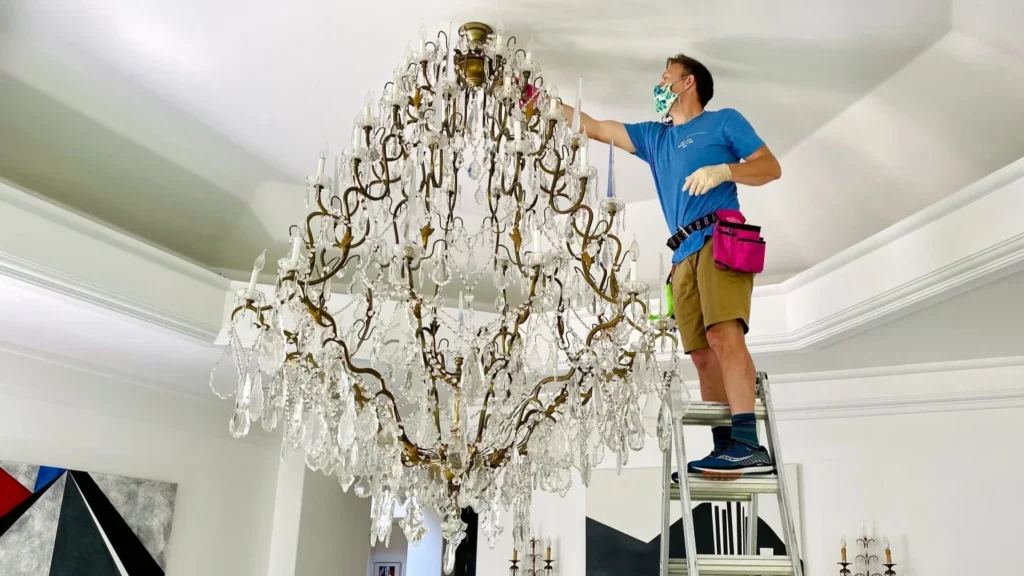
If you live in a villa in Emirates Hills or a high-rise in Business Bay, you know the “Dubai Dust” is a different breed. It is fine, relentless, and has a magnetic attraction to lead crystal. A chandelier that looked like a diamond last month can look like a hazy antique today. While many people assume they need a specialized team for every minor dusting, you can maintain that “showroom sparkle” yourself if you understand the physics of crystal and the environmental challenges of the UAE.
As someone who has managed deep cleaning for some of the most intricate lighting fixtures in the city, I have seen homeowners ruin Dh20,000 Swarovski pieces by using the wrong glass cleaner or, worse, rotating the fixture until the internal wiring snaps. Chandelier cleaning is 20% chemistry and 80% patience. In this guide, I will break down the exact professional protocols for cleaning chandeliers in Dubai, from high-ceiling safety to the “drip-dry” method used in luxury hotels.
Why Dubai Chandelier Cleaning is a Unique Challenge
In many parts of the world, dust is mostly skin cells and fabric fibers. In Dubai, it is a mix of silica sand, construction particulates, and—if you live near the coast—salt spray. When this mixture meets the humidity of a coastal evening or a fluctuating AC system, it creates a “crust” on the crystal that a simple feather duster cannot move.
The Static Electricity Problem
Most people use synthetic dusters. These create a static charge on the crystal, which literally sucks more dust out of the air the moment you finish. To truly clean a chandelier here, you have to neutralize that charge. If you are also managing AC filters and vents cleaning, you will notice that the cleaner your air, the longer your crystals stay bright.
The “Tarnish” Factor
The humidity in the UAE can cause the metal pins (the tiny wires holding the crystals together) to oxidize. If you use a water-heavy cleaning method, you accelerate this rust. A professional DIY approach uses low-moisture techniques to protect the structural integrity of the piece.
Preparation: The “Don’t Shatter It” Checklist
Before you even touch a ladder, you need to prep the “drop zone.” One falling crystal can crack a marble floor or a glass dining table.
-
Turn Off the Power: Not just at the switch, but at the breaker if possible. Wet cleaning and live electricity are a fatal combination.
-
The Moving Blanket Rule: Place a thick, padded moving blanket directly under the chandelier. If a crystal drops, it bounces on the padding rather than shattering on the floor.
-
The “Photo Map” Technique: Use your phone to take 10-15 high-resolution photos of the chandelier from every angle. When you take pieces off to clean them, you will forget where they go.
-
Cool Down Time: LED bulbs stay cool, but halogen or incandescent bulbs need 30 minutes to cool down. Touching a hot bulb with a damp cloth can cause it to explode.
The Two Main Methods: “Glass-On” vs. “Glass-Off”
Depending on the state of your fixture and your available time, you will choose one of these two professional paths.
Method 1: The “Drip-Dry” (Glass-On)
This is best for maintenance cleans every 3-4 months. It involves spraying a specialized solution and letting it gravity-drain the dirt away.
-
Pro Tip: Do not use standard window cleaner. Most contain ammonia, which can eat through the gold or silver plating on the frame. Use a mix of 1 part Isopropyl alcohol to 3 parts distilled water.
-
The Process: Wrap the light sockets in small plastic bags or cling film. Spray the crystals until they are dripping. The alcohol-water mix will dissolve the dust and evaporate without leaving streaks.
Method 2: The Deep Soak (Glass-Off)
If you haven’t cleaned the fixture in a year, you must remove the crystals.
-
The Setup: Line a plastic bin with a rubber mat (to prevent chipping). Fill it with lukewarm distilled water and a drop of organic dish soap.
-
The Rinse: Rinse in a second bin of distilled water mixed with a splash of white vinegar. This ensures a “squeak-clean” finish.
-
The Drying: Lay them out on a lint-free towel. Never use paper towels; they leave tiny fibers that look like spiderwebs under light.
Tool Comparison for Dubai Homeowners
| Tool | Professional Use | DIY Substitute |
| Ultrasonic Cleaner | Deep cleaning intricate pins | Plastic bin with soft brush |
| Lint-Free Cotton Gloves | Handling crystals without prints | Clean white socks (in a pinch) |
| Scaffolding/A-Frame | High ceiling access | 12-foot fiberglass ladder |
| Compressed Air | Removing dust from sockets | Camera lens blower |
The Hidden Danger: The “Chandelier Spin”
I have seen several DIY disasters where the homeowner stood on a ladder and spun the chandelier to reach the other side. Never do this. Chandeliers are threaded onto a support rod. Spinning it can unscrew the fixture from the ceiling or twist the internal wiring until it shorts out. You must move the ladder around the chandelier, not the other way around.
If your chandelier is in an entryway with a 6-meter ceiling, do not attempt a DIY clean on a standard ladder. This is when you should call for professional housekeeping services or a specialized chandelier team that uses industrial scaffolding.
How to Clean Specific Chandelier Materials
1. Swarovski and Lead Crystal
These have a high lead content, making them softer and easier to scratch. Use only microfiber or cotton. Avoid abrasive sponges at all costs.
2. Venetian and Murano Glass
These often have colored elements or hand-blown shapes with “nooks” where dust settles. A soft-bristled makeup brush is the best tool for dry-dusting these before any liquid is applied.
3. Brass and Gold-Plated Frames
If the frame is looking dull, do not use a metal polish unless you are sure it isn’t plated. Most modern chandeliers are plated; a harsh polish will rub the gold right off, leaving you with ugly silver streaks. A damp cloth with distilled water is usually enough.
Case Study: The “Sandstorm” Recovery in Al Barari
A client called us after a particularly heavy dust storm. They had left their terrace doors open, and their 2-meter wide crystal chandelier was coated in a layer of fine red silt.
The Mistake: They tried to wipe it dry with a cloth. The silt acted like sandpaper, creating micro-scratches on the bottom tier of crystals.
The Solution: We used a “touchless” air-compressor to blow off the heavy grit first, then used a high-volume distilled water spray to flush the remaining silt without any friction.
The Lesson: Never wipe a dusty chandelier in Dubai while it is dry. You must lubricate the surface with a cleaning solution to lift the grit away from the glass.
Maintaining the Glow: A 12-Month Schedule
-
Monthly: Use a long-reach ostrich feather duster (the only duster that actually traps dust rather than moving it) for a quick pass.
-
Quarterly: Perform a “Glass-On” spray clean using an alcohol-distilled water solution.
-
Yearly: A full “Glass-Off” deep clean. This is also a good time to check your patio cleaning needs, as outdoor dust eventually finds its way to your indoor fixtures.
Frequently Asked Questions
Can I use a steam cleaner on my chandelier?
I advise against it. Sudden temperature changes can cause old or low-quality crystals to crack (thermal shock). Additionally, the moisture can seep into the electrical components.
Why does my chandelier look “cloudy” after cleaning?
You likely used tap water. Dubai’s tap water is desalinated and contains minerals that leave a white film (limescale) when they dry. Always use distilled water for the final rinse.
How do I clean the lightbulbs?
Wipe them with a dry microfiber cloth while they are cold. If they have a greasy film, use a tiny bit of rubbing alcohol. Never spray liquid directly onto the bulb base.
Is it worth getting a professional chandelier clean?
If the fixture is over 3 meters high, has more than 100 individual crystals, or is an antique, yes. The risk of a fall or damaging the wiring outweighs the cost of a professional service.
Conclusion: Bringing the Light Back
A clean chandelier doesn’t just look better; it actually increases the light output of your room by up to 30%. In a city that celebrates luxury and light, keeping your fixtures in top condition is a point of pride. Follow the rules: no spinning, no ammonia, and always use distilled water.